 Türkçe
 Deutsch
What Are Debit and Credit in Accounting?
Debit and credit are two of the most often confused ideas in accounting. Here we explain them clearly, with a worked invoice and collection example.
Debit and credit are often confusing for business owners and students alike. Yet understanding these basic concepts is the key to recording financial transactions correctly and managing a business's finances well. The logic of debit and credit may look difficult at first, but it rests on a few simple principles. In this article we answer the question "what are debit and credit in accounting?" and explain why they matter in business. We look at how they are applied in accounting records, how the relationship between debit and credit works and why this knowledge is vital for businesses. If you want to understand your financial statements better and assess the economic position of your business correctly, this article gives you a solid starting point.
The basic logic of debit and credit
One of the most fundamental ideas in accounting is the relationship between debit and credit. A single sentence is enough to understand it: the receiver is debited, the giver is credited.
Take an example from everyday life. When you give a friend TRY 100, the money leaves you and goes to your friend: you are now the creditor and your friend the debtor. In the same way, when you take TRY 100 from your friend, the money leaves them and comes to you, so you become the debtor and your friend the creditor.
The same principle applies in accounting: the account that receives is debited, the account that gives is credited. In other words, the account money goes into is debited and the account it comes out of is credited. The same logic applies to documents such as invoices, cheques and promissory notes. When a company issues an invoice to a customer, for example, the customer is debited because they have received the goods or service.
The most important rule of the accounting system is that total debits always equal total credits. Money that goes into one account must always have a source. This keeps the trial balance, which shows the debits and credits of every account, in balance as well. Thanks to this balanced structure, the financial position of the business can be followed accurately.
How do debit and credit appear in accounting records?
Applying debit and credit correctly is essential for sound financial records. So how do these concepts show up in the books?
Balance is the rule in accounting entries. In every transaction, total debits must equal total credits. Money going into an account (the debit side) must always have a source (the credit side). This basic principle is the essence of double-entry bookkeeping.
For example, when TRY 1,000 goes into the cash account, the cash account is debited (money goes into the till) and another account is credited (the money comes out of somewhere else). Wherever it comes from, money going into the till is recorded on the debit side.
What happens when the business issues an invoice to a customer? The customer receives the invoice, so the customer account is debited: under the principle that the receiver is debited, the customer has received the goods or service.
In the resulting trial balance, total debits equal total credits and total debit balances equal total credit balances. This equality in the trial balance shows that the records are correct.
Every transaction, whether an invoice, a collection, a payment, an expense or a cheque or note, is recorded with this logic, and the balance between debit and credit is kept each time. This lets the financial position of the business be followed and reported accurately.
Accounting for an invoice and its collection
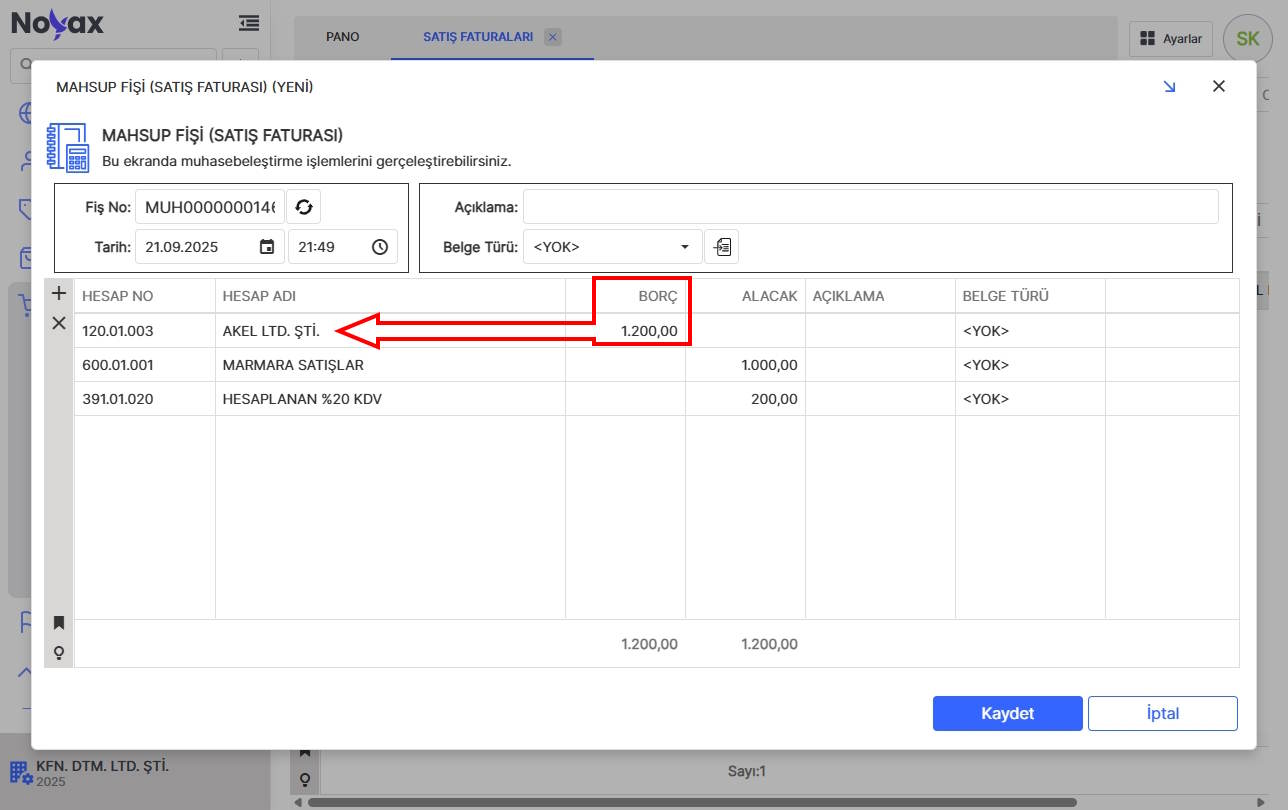
Below is the journal entry for an invoice. The company has issued its customer an invoice for TRY 1,000 plus VAT, and the customer (account 120.01.003) has been debited TRY 1,200.
If the customer later pays the amount in cash, the following entry is made. This time the customer (account 120.01.003) is the giver, so it is credited. Our account 100 Cash is the receiver, so it is debited.
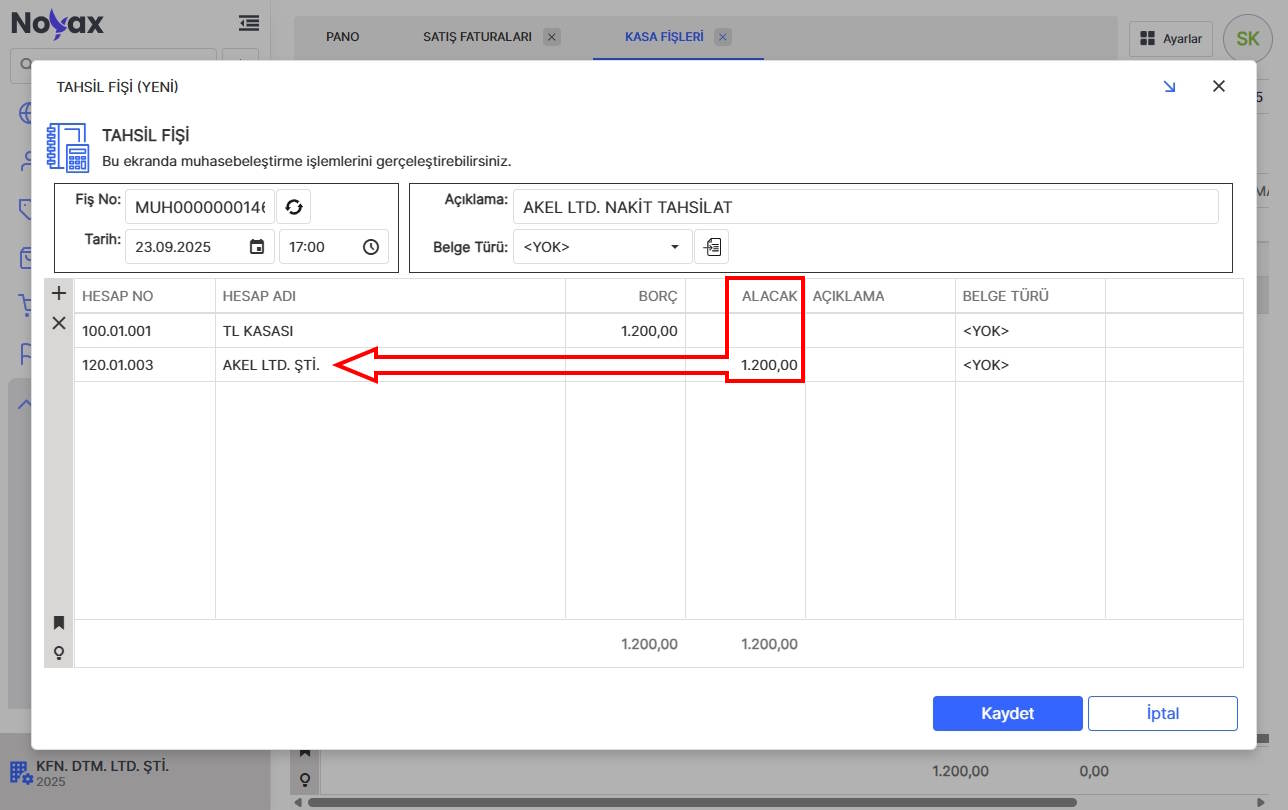
Customer account 120.01.003 was debited TRY 1,200 by the invoice and credited the same amount by the collection. Its final balance is therefore TRY 0.00.
Frequently asked questions
Q1. What do debit and credit mean in accounting? In accounting, debit is the left side of an account and credit the right side. As a basic principle, the receiver is debited and the giver is credited. These concepts are used to record and track financial transactions.
Q2. How is a debit or credit balance calculated? The balance of an account is the difference between the amounts on its debit and credit sides. If the debit side is larger, the account has a debit balance; if the credit side is larger, a credit balance. These balances show the financial position of the business.
Q3. How are debit and credit shown in accounting records? They are usually shown in T-accounts, with debit on the left and credit on the right. Each financial transaction is recorded on the relevant side of these accounts.
Q4. Why does the balance between debit and credit matter? It makes the accounting system accurate and reliable. Total debits and credits must be equal in every transaction. This balance ensures that the financial position of the business is reflected correctly and that the trial balance balances.
Q5. How does general ledger software make tracking debits and credits easier? Accounting software records and balances debit and credit entries automatically. It posts invoices, collections and payments immediately, keeps expense records in order and handles documents such as cheques and notes. This reduces the risk of human error and lets you follow your financial position in real time.
Conclusion and recommendation
Debit and credit are the indispensable building blocks of financial records. Put simply, the principle that "the receiver is debited, the giver is credited" is the essence of all accounting. Once understood, these concepts are quite logical and offer a systematic way of recording every financial transaction.
Keeping debits and credits in balance is the key to reflecting the financial health of your business correctly. The balance you see in the trial balance shows that all of your transactions have been recorded properly. Understanding these concepts is therefore vital not only for understanding accounting but also for assessing the economic position of your business correctly.
Today, accounting automation makes this seemingly complex system much easier to manage. Modern software keeps debits and credits in balance automatically and records your transactions without errors, which is a real advantage for business owners and accounting professionals.
Any business owner who wants a solid accounting foundation should first get to grips with these basic concepts. Once you understand debit and credit, you can interpret your financial statements better and make better strategic decisions for your business. And you will see that accounting is not a complicated science but a systematic way of recording, built on clear principles.