
 Türkçe
 Deutsch
What Is Real Growth? How to Calculate Inflation-Adjusted Growth
Your sales are up on last year, but did you really grow once inflation is taken out? We explain what real growth is, how to calculate it and the most common mistake, with examples.
Are your sales really growing?
Last September you sold TRY 1,000,000; this September, TRY 1,340,000. At first glance that is 34% growth. But if prices also rose by about 30% over the same period, how much of that growth comes from doing more business, and how much simply from higher prices?
When inflation is high, figures in lira are misleading. A business that has not grown at all, or has even shrunk, can still see its sales figures rise every year. The answer to this question is real growth.
In this article we explain, with examples, what real growth is, how it is calculated, the most common calculation mistake and how to interpret the result.
What is real growth?
Real growth is the growth that remains after the effect of price increases, that is, inflation, has been removed from an increase in an amount. It shows how much your sales have increased when measured at last year's prices rather than today's.
Two concepts need to be kept apart:
- Nominal growth: the change in the amount in lira. It is calculated from the total of your invoices and includes price increases.
- Real growth: nominal growth with the effect of inflation removed. It shows whether the business has grown in volume, that is, in terms of purchasing power.
If nominal growth is above inflation, real growth is positive. If it is below, your rising sales in lira actually mean a real decline.
Why does real growth matter?
Most business decisions start with the question "where are we compared with last year?": hiring, investing, updating prices, setting stock levels. When inflation is high, answering this question with lira figures can lead to wrong decisions.
- It shows real performance. It separates growth that comes from price increases from growth that comes from selling more products to more customers.
- It tests your prices. If you are shrinking in real terms, either you are selling less or your prices have fallen behind inflation.
- It reveals cost pressure early. If your purchases are growing faster than your sales in real terms, your profitability may be shrinking.
- It compares periods fairly. Lira amounts from different years reflect different price levels. Real values remove this difference and make the comparison meaningful.
How is real growth calculated?
You need the amounts for two periods and the inflation rate between them. The formula is:
Real growth = (amount this period ÷ amount in the previous period) ÷ (1 + inflation rate) - 1
Let us calculate the example from the introduction step by step:
| Item | Value |
|---|---|
| Last September | TRY 1,000,000 |
| This September | TRY 1,340,000 |
| Growth in lira (nominal) | +34.0% |
| Annual CPI (September) | 29.8% |
| Real growth | +3.2% |
- Divide this year's amount by last year's: 1,340,000 ÷ 1,000,000 = 1.34. Your sales have risen 34% in lira.
- Add the inflation rate to 1: 1 + 0.298 = 1.298. Prices have risen to 1.298 times their level on average.
- Divide the first result by the second: 1.34 ÷ 1.298 = about 1.032.
- Subtract 1: 1.032 - 1 = 0.032. Real growth is +3.2%.
You reach the same result by converting this year's sales to last year's prices: 1,340,000 ÷ 1.298 = about TRY 1,032,000. Measured at last year's prices, you did about TRY 1,032,000 of business this September, an increase of 3.2% on last year's TRY 1,000,000.
The most common mistake: subtracting inflation
The most common shortcut is to subtract inflation from nominal growth: 34.0% - 29.8% = 4.2 points. This gives a roughly correct result when inflation is low, but the higher inflation is, the more it inflates the result.
In our example, subtraction gives 4.2 points while the correct result is 3.2%, a difference of one point. The gap widens as inflation rises:
| Growth in lira | Inflation | By subtraction | Correct calculation |
|---|---|---|---|
| 34.0% | 29.8% | +4.2 points | +3.2% |
| 80.0% | 70.0% | +10.0 points | +5.9% |
| 25.0% | 29.8% | -4.8 points | -3.7% |
The last row shows something else that matters: sales that grew 25% in lira are, against 29.8% inflation, actually a real decline of 3.7%. That is hard to notice when you only look at rising figures.
Which inflation rate should you use?
The most widely used inflation indicator in Turkey is the Consumer Price Index (CPI, TÜFE) published monthly by the Turkish Statistical Institute (TÜİK). Which rate you use depends on what you are comparing:
- If you compare a month with the same month last year, use that month's annual CPI change. If you compare September with September, take September's annual inflation.
- If you compare a month with the previous month, use the monthly CPI change. Because of seasonal effects such as holidays, seasons and year end, however, this comparison is misleading for most businesses; comparing the same months is sounder.
- If you compare annual totals, that is, the last 12 months against the previous 12, TÜİK's change "according to twelve-month averages" is the more suitable measure.
When assessing your purchases, the Domestic Producer Price Index (D-PPI, Yİ-ÜFE) is another option. Still, adjusting sales and purchases with the same rate makes it easier to compare the two.
How do you interpret the result?
Real growth is not a grade on its own; you need to find the reason behind it.
- If real growth is positive, either you are selling more or you have raised your prices by more than inflation. Look at your unit sales: if they are rising too, the growth is solid. If the amount rises while units fall, price is carrying the growth, and that may not last.
- If real growth is negative, your prices have fallen behind inflation or you are selling less. Look at which products and which customers are shrinking, one by one.
- Read sales and purchases together. If your purchases are growing faster than your sales in real terms, either you are building up stock or you cannot pass cost increases on to your prices.
- Look at the trend, not a single month. A campaign, a large order or a holiday falling in another month can move a single month. Real growth that moves in the same direction for several months in a row means much more than one month's result.
- Treat the current month with care. A comparison made before the month is over is incomplete. Comparing this month with the same days last year gives a more accurate picture.
See real growth in one click in Noyax
You do not need to do this calculation by hand every month. The Monthly sales / purchases card on the Noyax Dashboard shows the sales and purchase invoices of the last 12 months, including the current month, side by side as columns. The two boxes in the card's header answer the questions in this article:
- Previous year: each month's sales and purchases from last year appear as dashed lines above the columns.
- Real growth: below the columns, each month's inflation-adjusted growth compared with the same month last year opens up. If the bar points up, you grew faster than inflation that month; if it points down, you shrank.
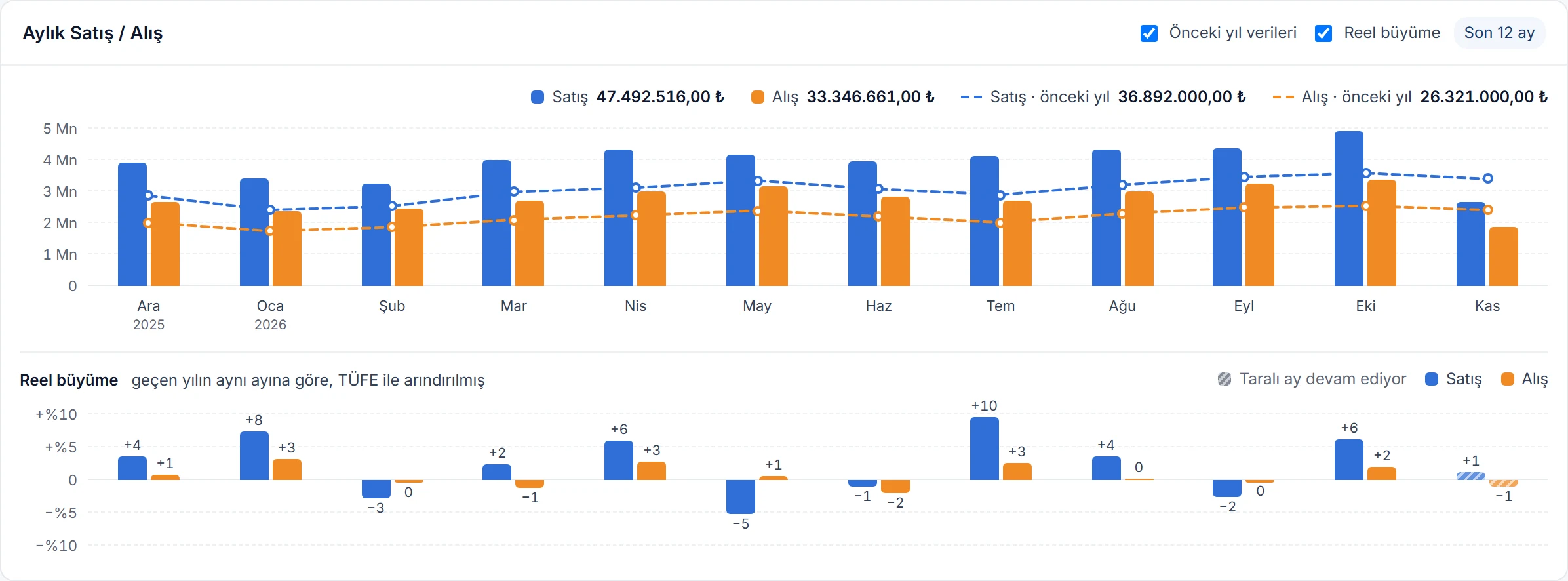
The calculation uses the formula in this article. Annual CPI from the data service of the Central Bank of the Republic of Turkey (TCMB) is used as inflation, and the same rate applies to sales and purchases. Hover over a bar to see last year's and this year's amounts, the growth in lira, the annual CPI and the real growth together.
The current month is compared with the same days last year and calculated with the CPI of the most recently published month. Real growth is shown when the company's default currency is the Turkish lira.
The Dashboard is available in every Noyax account. Try Noyax free for 14 days and set up your dashboard the way you want.
Key takeaways
- Real growth is the growth that remains after removing the effect of inflation from growth in lira.
- Formula: (this period ÷ previous period) ÷ (1 + inflation) - 1.
- Subtracting inflation from nominal growth makes the result look better than it is, and more so the higher inflation is.
- When comparing the same months, use that month's annual CPI; for annual totals, use the change according to twelve-month averages.
- Read real growth together with unit sales and purchases, as a trend over several months.
Frequently asked questions
What is the difference between real growth and nominal growth?
Nominal growth is the change in an amount in lira and includes price increases. Real growth is what remains after removing the effect of inflation from that change, and it shows whether the business has grown in volume.
What does negative real growth mean?
Even if your sales have risen in lira, the increase has fallen behind inflation. Measured at last year's prices, you have done less business. The usual reasons are falling unit sales or prices that have not kept up with inflation.
Which inflation data is used to calculate real growth?
Usually the CPI published by TÜİK. When comparing the same months, use that month's annual CPI change; when comparing annual totals, use the change according to twelve-month averages.
Why is it wrong to subtract inflation from nominal growth?
Subtraction is an approximation that only comes close to the right answer when inflation is low. The higher inflation is, the better it makes the result look: with 34% growth and 29.8% inflation, subtraction gives 4.2 points while the correct result is 3.2%.


