 Türkçe
 Deutsch
How to Calculate the Average Due Date
When a payment is split across several cheques or notes, each with its own amount and due date, how do you find the average due date? Here is the formula, an Excel example and how Noyax does it for you.

Calculating the average due date is one of the most important calculations in managing your business's cash flow. If your financial planning is off, you can run short of cash or miss growth opportunities.
That is why it matters so much to work out the weighted average due date of payments and collections made by cheque and promissory note. If you work with several payment instruments, doing this by hand takes a lot of time. Excel formulas or software that calculates the average due date of cheques and notes make the process much easier.
In this article we explain the basics of the average due date step by step, show how to calculate it in practice and how to get quick results in Excel. We also introduce digital tools that save time and make your financial planning more efficient.
The average due date formula
Cheques and promissory notes are widely used in business in Turkey. Payments are often made not on a single due date but with several cheques or notes spread over different dates. To manage your cash flow properly in this situation, you need the average due date.
The calculation is needed in two cases in particular: when the due dates are not evenly spaced and when the amounts differ. It takes the weighted average of the payments and gives a single date, as if all of them were to be paid on that day.
The formula is:
Average term in days = (days to 1st due date × amount + days to 2nd due date × amount + … + days to nth due date × amount) / total amount
Average due date = date of the cheque batch + average term in days
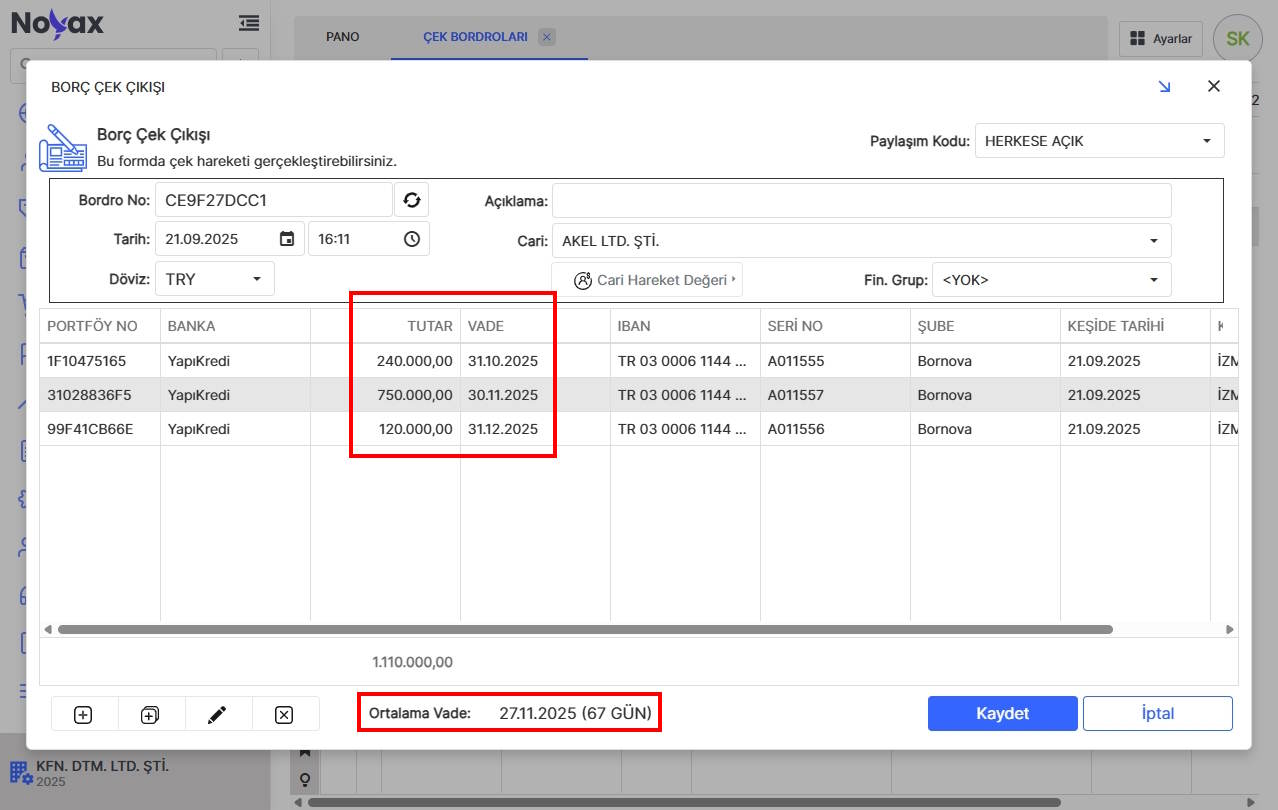
Suppose you have three cheques:
- TRY 240,000 due on 31 October 2025
- TRY 750,000 due on 30 November 2025
- TRY 120,000 due on 31 December 2025
If you received these cheques on 21 September 2025, the average due date calculation tells you the cash will come in 67 days later, on 27 November 2025. This information plays an important part in your financial planning and helps you predict your cash flow.
Calculating the average due date in Excel
Excel can be used to calculate a single average due date for cheques or notes spread over different due dates.
First, create a simple table with these columns:
- Due date
- Amount (TRY)
- Days to due date (counted from the batch date)
- Days × amount
Say our cheque batch is dated 21 September 2025 and contains these cheques:
- TRY 240,000 dated 31 October 2025
- TRY 750,000 dated 30 November 2025
- TRY 120,000 dated 31 December 2025
To calculate in Excel, work out the number of days to each cheque's due date from the batch date. Then multiply each cheque's days by its amount and divide the sum of these products by the total amount.
In English versions of Excel the formula is =SUMPRODUCT(C2:C4,B2:B4)/SUM(B2:B4).
In a Turkish version of Excel the same formula is written =TOPLA.ÇARPIM(C2:C4;B2:B4)/TOPLA(B2:B4).
Column C holds the days to each due date and column B the amounts. The formula calculates the average term automatically as 67 days.
As the number of cheques grows, this method gives much faster and more reliable results than calculating by hand.
Digital tools that save time
If you handle a large number of cheques and notes, calculating the average due date by hand takes a lot of time. Digital tools such as Noyax solve this problem, speed up your work and reduce the risk of errors.
Noyax calculates the average due date automatically as soon as you enter cheques and notes, so you do not have to work it out separately for dozens of them. The software reports the average term and the average due date instantly.
With the cash flow report in Noyax you can also see all the cheques you have received as cash inflows on their due dates. You can follow your cash position months ahead and plan your finances accordingly.
Digital tools like these make financial planning much easier, especially for businesses with a high volume of transactions, and give you a clearer view of your finances.
Frequently asked questions
Q1. What is the average due date and why does it matter? The average due date is a financial calculation that takes the weighted average of payments falling on different dates and gives a single payment date. It is critical for businesses to manage their cash flow and plan their finances.
Q2. How is the average due date calculated? Multiply the days to each payment's due date by its amount, add up these products and divide by the total amount: sum of (days × amount) / total amount.
Q3. How do I calculate the average due date in Excel? Use the SUMPRODUCT function, for example =SUMPRODUCT(days,amounts)/SUM(amounts), for quick and accurate results.
Q4. What are the advantages of digital tools for this calculation? Digital tools calculate the average due date automatically and without errors, which matters especially for businesses with many cheques or notes. They save time and make financial planning easier with cash flow reports.
Q5. How does an accurate average due date help a business? It lets the business foresee its future cash needs, so it can prepare for possible cash shortages, stay financially sustainable and improve its chances of reaching its growth targets.
Conclusion and recommendation
Calculating the average due date correctly is very important for the financial health of your business. By treating cheques and notes with different due dates as if they fell on a single date, you see your cash flow more clearly and can plan your finances accordingly.
Manual calculation may be enough for a small business, but as your volume grows, Excel formulas or digital tools such as Noyax make life much easier. If you work with many cheques and notes, these tools save time and reduce the risk of mistakes.
An accurate average due date also lets you see your future cash needs in advance and take precautions against cash shortages, which supports the financial sustainability of your business.
The more accurate your financial planning, the better your chances of reaching your growth targets. By using these methods effectively, you can manage your cash flow in the best possible way and secure your financial success.